CHAIR’S COLUMN
POLITICAL GEOGRAPHIES OF ATTACKS ON ACADEMIC FREEDOM
Academic freedom cannot be taken for granted. It must be used to be maintained and it needs to be defended against those who want to curtail it. Unfortunately, we witness an increase of attacks in many places across the globe. Time and again governments and political actors attempt to restrict it. Managerial universities also undermine academic freedom when they deploy commercial and productivity logics to organize research and teaching, aiming at maximizing their market share and their returns, managing their personnel according to marketable research priorities and protecting their corporate brand.
Some disciplines are more susceptible to such attacks than others. Humanities and social sciences are targeted because they deal with power relations and its justification. Many branches of geography research and teaching agendas are of utmost societal relevance, dealing with national territory and borders, biopolitics and geopolitics, resources and environmental issues, climate change, social injustices and power imbalances, ethnic identities, postcolonial legacies, gender, reproductive rights and health care, migration, housing… Topics, methods and results of geographical research are often of high relevance to legitimate or to contest political power.
Some governments maintain direct control on academia, both on research as in teaching activities. In other countries control is more volatile, changing with the political regime. New governments may announce measures to discourage or straightly ban certain approaches at the university, curtailing funding or decreasing teaching hours. For example, in Brazil, funding for science, technology and education is plumbing in all areas, but is virtually disappearing for human science, which is depicted in many media as superfluous gibberish. Yet in other countries, the attacks on academia are coming from political parties and public actors at the margins of the political and public debates.
The past few years have witnessed an expansion on the scope of attacks, including intimidation, harassment, exclusion and lay-off, arrestation, imprisonment and prosecution, as well as travel bans imposed on foreign academics. Less direct but pernicious harassment is even more common, including slander campaigns in conventional and social media and even death threats. In Western Europe collective attacks have targeted the humanities and the social sciences; these condemnations sometimes come from high-ranking politicians in government positions (such as the former US president Trump, the Brazilian president Bolsonaro and his ministers, the French and the Greek ministers of higher education) and mainstream media.
The list is sadly so long that it is hard to acknowledge all the names, but a quick review will suffice. Central American University in Budapest was the highest ranked university in Hungary before it was targeted by the Prime Minister and his government and forced to relocate to Vienna in 2019. The attacks on academic freedom in Turkey since the mid-2010s through criminalization of Academics for Peace, an association of Turkish academics who support a peaceful solution to the Kurdish Turkish conflict, and the attacks on academics in and outside China publicizing the situation in Xinjiang are among the most shocking, and affected geographers among others. This includes a member of the IGU Commission on Geography of Education and the Chinese physical geographer of Uighur descent Tashpolat Tiyip, president of Xinjiang University from 2010 to 2017 (whose family has been informed that he had been sentenced to death in a secret trial for ‘separatism’ in 2017 and whose whereabouts are unknown since, apart from a statement of the Ministry of foreign Affairs that he was charged with corruption). In 2021, our colleague Larissa Mies Bombardi (Universidade de São Paulo) had to flee Brazil because of death threats following her work on pesticides (Bombardi 2017). Our colleague Rachele Borghi (Université Paris-Sorbonne) was harassed because of her work on queer geographies, and our colleague and steering group member Anne-Laure Amilhat Szary (Université Grenoble Alpes) was singled out as a representative of the alleged islamoleftist hegemony in French universities (see below for more details) and harassed on conventional and social media.
For academics there are few options apart from expressing our solidarity, individually or collectively, with those targeted by repression, maintaining the conversation about academic freedom and about human rights and other values, and contributing to the exposure of malpractices. Scholars at Risk is a U.S.-based international network of academic institutions organized to support and defend the principles of academic freedom and to defend the human rights of scholars around the world. Members of the network are 548 higher education institutions in four dozen countries. Their Academic Freedom Monitoring Project investigates and reports attacks on higher education. For the period April 2020- March 2021, 238 attacks were reported: 52 killings, violence, disappearances, 83 imprisonment, 43 prosecution, 26 loss of position, 4 travel restrictions and 30 other attacks (Scholars at Risk 2021). The network also offers legal counseling and publishes an annual report featuring the Academic Freedom Index (AFi) (Kinzelbach et al 2021). The index covers 175 countries and is based on the opinion of almost 2,000 country experts on five indicators regarding 1) the freedom to research and teach, 2) the freedom of academic exchange and dissemination 3) institutional autonomy, 4) campus integrity and 5) freedom of academic and cultural expression. The index also take into account factual information about the constitutional protection of academic freedom and about international legal commitment to academic freedom under the International Covenant on Economic, Social and Cultural Rights (ICESCR) which is an UN treaty signed in 1966 (for the details see Kinzelbach et al 2021: 8). From 2019 to 2020, the largest declines in academic freedom levels were experienced in Belarus, Hong Kong, Sri Lanka and Zambia. Countries with significant deterioration of their AFi over the past five years were Brazil, Nicaragua, Turkey, Hong Kong, Colombia and Zambia. Significant improvements were made in Gambia, Kazakhstan, Sudan, North Macedonia and the Maldives in the same period.
An analysis of the temporal-spatial diffusion of academic freedom and attacks on it is yet to be carried out but the pattern can be compared to that of political rights and civil liberties in the world (Figs 1 and 2).
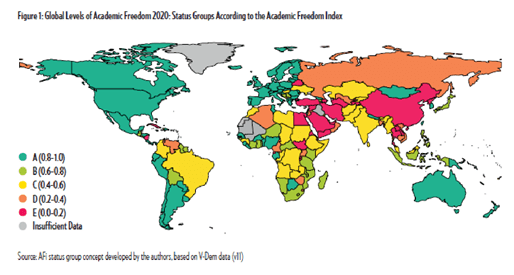
Figure 1: Global levels of Academic Freedom 2020. Source: Kinzelbach, K. I. Saliba, J. Spannagel & R. Quinn (2021) p.9
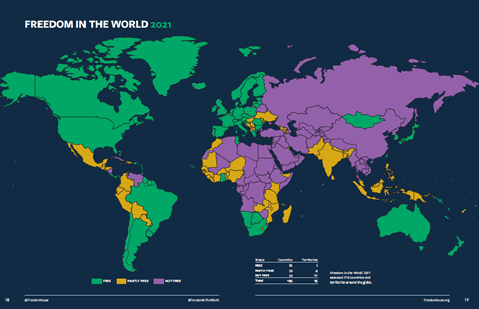
Figure 2: Political rights and civil liberties 2021. Source: Freedom House (2021) Freedom in the World. Democracy under siege, p. 18-19
Maximizing exposure of such infringements includes making the political geographies of attacks on academic freedom visible, building solidarity campaigns and refugee programs (when universities host academics in exile). Unfortunately, visibility is also unjustly distributed. The harassment of our colleagues in countries where the state or political movements are abusing human rights in general is so entrenched in overall illiberal and repressive societies, that we hardly record it. Apart from the circulation of information about such infringements of academic freedom and assaults on fellow academics, it is also key to maintain academic communication and debate, strengthen contact with colleagues working under duress and refrain from simplistic solutions like the boycott of entire academic communities because of the politics of their governments.
It is also important to maintain the conversation about the purpose and the nature of academia and struggle against simplistic representation of science and academic knowledge as neutral, value-free, and a-political and to discuss ethics. Time and again it is particularly important to question the “apolitical” posture some critics of academia take and to demonstrate how political and ethical positions inform research and teaching, even when they are not expressed explicitly.
Geographers are well positioned to contribute to these debates because geography is particularly diverse in terms of approaches and epistemologies and geographical institutions have been globally inclusive of widely different approaches such as positivism and critical rationalism, Marxist approaches and critical realism, phenomenology, poststructuralism and postmodernism, feminist approaches, queer geographies, more-than-human approaches and chaos theory. Moreover, geographers traditionally foreground societal relevance but again have shown a large diversity of professional practices. These applied practices range from the proverbial “aid to statecraft” in military campaigns, diplomacy, and foreign policy, as well as urban and regional development, through contributions to primary and secondary education, geographical literacy for the media, or applied geography for corporations, to activism for emancipatory movements focusing on individual emancipations or political movements aiming at political change, social justice, land and territory claims, and peace movements. Finally, geographers are well equipped to study processes through which academic freedom is attacked – or defended – through the socio spatial nexus between power and knowledge.
In 2018 our colleague Farhana Sultana (Syracuse University) was pivotal in a highly visible debate about the difference between academic freedom and freedom of speech in the American controversy following the publication a piece entitled ‘A Case for Colonialism’ by Bruce Gilley (Portland State University) in early September 2017 by the Third World Quarterly (TWQ), a well-respected journal of postcolonial development studies. The case was firmly rooted in the so-called ‘culture war’ in the United States and how it has impacted Northern American campuses for the past decades. It was particularly important because the debate was about the difference between freedom of speech (which includes the freedom to express white supremacist opinions and glorified European colonialism) and academic freedom that comes with academic habitus. Two petitions signed by thousands of academics, as well as open letters of members of the editorial board of the journal (half of them resigned) requested the retraction of the article, arguing that it lacked academic rigor and did not follow ethical publishing practices[1]. This controversy is also exemplary in the sense that the debate spilled over the academic circles and both the editor, the author and the more visible scholars problematizing the publication (including Farhana) received threats via social media. Even more problematic: Gilley’s article was eventually withdrawn by the publisher (Taylor & Francis, one of the leading academic journal publisher) with the threats to the editors as motive, a problematic precedent (NB: the article has been republished in 2018 in Academic Questions, the journal of the National Association of Scholars, a US non-profit politically conservative organization opposing political correctness on US campuses that was published by Springer until December 2020).
The attacks on the academic community also include institutional reforms that undermine academic freedom and a culture of harassment intimidating scholars, for example in the public debate. Let us take a few examples first from two countries where the AFi is mediocre and has recently dropped (Brazil scores in 2020 in the middle category and Turkey in the lowest) and two from countries where the AFi is high (Greece and France score in 2020 in the highest category).
In Brazil, the budget for education in 2021 is half of what it was in 2014 and almost 20% less than it was in 2020. Many scholarships were cancelled, especially in human science and in more marginal universities. This means that many poorer students will not be able to pursue their education (ANPEGE 2020). Since 2019, twenty-five rectors have been appointed by the Education Ministry against the choice of the university communities and violating their autonomy (ANDES 2021). Key managerial positions in agencies for technology, research and education are now staffed with military personnel with little knowledge of its responsibilities (Costa 2021). In some research institutes, such as ICMBio (researching biodiversity) and IPEA (dedicated to economics analysis) this staff oversees papers and reports prior to publication (Escobar 2021). Education in crisis means, of course, an intense brain drain, together with frequent news about scientists who leave the country to escape harassment. Persecution towards researchers who criticize government policies (and lack of) towards covid19 pandemics are also commonplace, following the lead of the president himself (Hallal 2021). Discrediting science and its recommendations towards COVID-19 control is costing a huge price on human lives in Brazil[2].
Early 2021 the Turkish president appointed an unelected rector to Boğaziçi University (aka Bosphorus University) in Istanbul led to protest from academics and students, as it breaches the law regarding the autonomy of university and the non-partisan affiliation of rector (the appointed rector run for candidate for the ruling party at the 2015 elections). Mass protests were followed by intimidations and arrestations. Among the new rector’s first decisions were the closure of a student LGBT club and the appointment of a physics professor as the rector of social sciences. Staff members have filed a case at the constitutional court. The former elected Üstün Ergüder, a political scientist, was personally targeted by the Minister of Interior as responsible for the protest, hundreds of people were arrested (see Gokmenoglu 2021).
In Greece a new Bill on Higher Education proposed by the Minister of Education Niki Kerameus and Minister of Police of the New Democracy government in February 2021 is threatening academic freedom and bringing special police forces on campuses. It was paralleled by slandering campaigns representing universities as centers of lawlessness and attacking academics opposing the new law personally in the media. When it came to power in 2019, the political party New Democracy abolished campus immunity from police entry, known as asylum, dating from the re-establishment of democracy in Greece and a law of 1982 (that gives campuses a status quite like that in churches in many countries). Students’ protests had been key in the dismissal of the Greek junta. In November 1973, the Colonels’ regime had sent tanks to violently end a student occupation of Athens Polytechnic killing dozens of people. In 2011, a socialist government (PASOK) partly repealed campus asylum, allowing rectors to invite police on their own authority. The left-wing Syriza party restored it in 2017. The status was revoked in 2019 by the New Democracy government.
The new 2021 Bill goes further than the abolition of the asylum status, installing a new police force directly ruled by the Greek police and implementing systematic surveillance on campuses. It undermines the principle of self-rule and transforms the universities in sites of control, repression, and policing. The Bill is opposed by a wide alliance of university senates, teachers’ and students’ associations and the initiative of academics No Police on Campus #NoUniPolice, but also the Federation of Greek Police officers. To add insult to injury the government reserved no less than €50 million for the university police (both salaries and surveillance technology), while the total budget of the Greek universities – undermined by severe underfunding since the 2008 financial crisis – is € 91 million (according to Dirou 2021).
In the French, the depreciation of the universities aggravated after the assassination of Samuel Paty, a secondary school teacher of geography history and civism, in mid-October by a young refugee of Chechen origin that wanted to silence him after Islamic activists targeted him on social media for having shown satiric cartoons from Charlie Hebdo in class. In that context several Ministers and people’s representatives of the presidential party accused the university of promoting Islamic terrorism. They hinted at the hegemony of islamogauchisme (islamoleftism) at the university in research and education programme. The label, originally coined by the academic Pierre-Henri Taguieff at the turn of the century as a descriptive label of the alliance between the extreme left and pro-Palestinian movements during the intifada, has entered the public discourse social and conventional media to criticize the humanities and social sciences and more specifically feminist approaches (especially the notion of intersectionality), critical race studies, postcolonial theories and queer studies as ‘American inventions’ perverting French university and French youth and undermining French society. Frédérique Vidal, the Minister of Higher Education, even announced she wanted to commission a study on the phenomenon and on political opinions of academics and develop a policy to counter these influences. The Minister of Education and the Minister of Interior as well as several members of parliament for La République en Marche (the centrist movement of President Macron) have relayed such attacks and such representations have been also relayed by some academics and by the conventional media. Many other academics as well as research institutions such as the Convention of University Presidents and the CNRS criticized the notion of islamoleftism and the plans to control political opinions among academics and their research topics.
Both the concept of islamoleftism and the idea for such a monitoring have been rejected by key official academic instances, including the Conseil national des universités CNU (the national agency supervising the careers of academics in France and organized in disciplinary sections), the Centre national de la recherche scientifique CNRS (the National Centre for Scientific Research) and the Conférence des présidents d’université CPU (the Conference of University Presidents). In addition, a petition has been signed by 23,000 academics, demanding the resignation of a minister that does not trust nor represent them. Moreover, they see the criticisms of the politicians as attempts to divert the attention from the underfunding of French universities and the latest Reform Bill for research and higher education that reduces academic freedom and increases precarity. In turn, the Minister and her supporters see the massive support for the petition, as a proof of the hegemony of islamoleftism, instead of reading it as an outcry from exasperated academics defending their profession.
Meanwhile individual academics have been explicitly accused of promoting this alleged islamoleftism and harassed on conventional and social media for their work on race relations or on sexualities, for their opposition to the new reform or for their support for the petition. In March 2021 an incident in Grenoble where posters accusing two lecturers of islamophobia were publicized on social media generated a broad condemnation (with Paty’s murder in mind). The events took a surprising turn when one of the targeted lecturers seized the occasion to enter the public debate and give numerous interviews and appearances in talk shows. In his interventions he systematically shifted the attention from the anonymous public accusation (coming most likely from some of his students), his teaching and his contribution to polarization on the campus, to his accusation against his colleagues that he labelled islamoleftists, suggesting that they called a fatwa against him (using deliberately a term from the Islamic legal vocabulary) and singling out the head of the research department PACTE because as a director she had intervened a few months earlier in an unrelated incident between the lecturer and a researcher he had harassed. The claim was relayed and amplified nationally by conventional media (both television and press). The staging of our colleague Anne-Laure Amilhat Szary and her department as the personification of islamoleftism prompted a slander campaign on social media including death threats.
These examples show that academic freedom should be taken for granted (not even in countries with a high AFi) and that an unusual collusion between mainstream politicians (including the Minister in charge of universities) and social media targets academics collectively and individually. The collective denigration of the humanities and the social sciences (as ‘political’, ‘activist’ and ‘a-scientific’) and individual harassment (partly anonymously via the social media) pave the way to institutional reforms to roll back academic freedom. In that context, pointing at countries where the predicament of academics is structurally much more acute (countries with a low AFi) can be an easy way to belittle and silence academics in countries where civil liberties and academic freedom are generally more protected. It is important however to take a stand against any attempt to delegitimize academic research and criminalize critical thinking. Fortunately, several solidarity statements from diverse associations of (political) geographers in France and abroad (including IGU and our commission) were published (IGU 2021).[3] They do not only serve for mental support to targeted academics, but they also aim at making the wider issue at stake visible in the public debate: the mission of universities and the importance of academic freedom for that mission.
Hopefully, academic solidarity networks such as Scholars at Risk, but also disciplinary associations such as the International Geographical Union, can help targeted academics cope with adversity and protect those more at risk from oppression. (Political) geography can also contribute to a better understanding of the nexus of power and knowledge behind the processes impacting academic freedom (positively or negatively). And for sure (political) geography could not thrive without academic freedom.
Virginie Mamadouh & Adriana Dorfman, CPG Co-Chairs
References
ANDES – Sindicato Nacional dos Docentes das Instituições de Ensino Superior 2021. Militarização do governo Bolsonaro e intervenção nas instituições federais de ensino http://www.andes.org.br/diretorios/files/renata/abril2021/DossieMilitarizacao.pdf
ANPEGE – Brazilian National Association of Research and Graduate Schools in Geography 2020. Ata fórum de coordenadores da ANPEGE – online 30 e 31 de julho de 2020. http://www.anpege.ggf.br/documento.php?id=48
Bombardi, L. M. (2017). Geografia do Uso de Agrotóxicos no Brasil e Conexões com a União Europeia. São Paulo: FFLCH – USP. https://conexaoagua.mpf.mp.br/arquivos/agrotoxicos/05-larissa-bombardi-atlas-agrotoxico-2017.pdf
Costa, Vivian (2021). Mais um ano de enfrentamento. Jornal da Ciência. http://portal.sbpcnet.org.br/noticias/mais-um-ano-de-enfrentamento/
Dirou, E. (2021). Exiting democracy, entering authoritarianism: state control, policing and surveillance in Greek universities, Crime Talk, 15 March 2021 https://www.crimetalk.org.uk/index.php/library/section-list/1012-exiting-democracy-entering-authoritarianism
Escobar, Herton (2021). ‘A hostile environment.’ Brazilian scientists face rising attacks from Bolsonaro’s regime. https://www.sciencemag.org/news/2021/04/hostile-environment-brazilian-scientists-face-rising-attacks-bolsonaro-s-regime
Freedom House (2021) Freedom in the World 2021: Democracy under Siege. Washington DC: Freedom House https://freedomhouse.org/report/freedom-world/2021/democracy-under-siege
Gokmenoglu, B. (2021). The struggle at Turkey’ s Boğaziçi University, Public Seminar, 1 April 2021, https://publicseminar.org/essays/the-struggle-at-turkeys-bogazici-university/
Hallal, Pedro (2021) SOS Brazil: science under attack. The Lancet Journal, v. 397, issue 10272, p.373-374. https://www.thelancet.com/journals/lancet/article/PIIS0140-6736(21)00141-0/fulltext?rss=yes
Kaniadakis, E. (2021). Why are Greece’s students and tutors so set against a university police force? Euronews 11 February 2021, https://www.euronews.com/2021/02/11/why-are-greece-s-students-and-tutors-so-set-against-a-university-police-force
Kinzelbach, K. I. Saliba, J. Spannagel & R. Quinn (2021). Free Universities Report March 2021 Putting the Academic Freedom Index Into Action. Berlin: Scholars at Risk Network/Global Public Policy Institute. https://www.gppi.net/media/KinzelbachEtAl_2021_Free_Universities_AFi-2020.pdf
Perrotin, D. (2021). How ‘Islamophobia’ row erupted at French political sciences school, Mediapart 22 March 2021, https://www.mediapart.fr/en/journal/france/220321/how-islamophobia-row-erupted-french-political-sciences-school translation of Accusations d’islamophobie: la direction de Sciences Po Grenoble a laissé le conflit s’envenimer, Mediapart, 11 March 2021 https://www.mediapart.fr/journal/france/110321/accusations-d-islamophobie-la-direction-de-sciences-po-grenoble-laisse-le-conflit-s-envenimer
Scholars at Risk (2021). Academic Freedom Monitoring Project https://www.scholarsatrisk.org/academic-freedom-monitoring-project-index/
Sultana, F. (2018). The false equivalence of academic freedom and free speech. ACME: An International Journal for Critical Geographies, 17(2), 228-257. https://www.acme-journal.org/index.php/acme/article/view/1715
[1] Farhana Sultana has written an academic article on the subject published in ACME (Sultana 2018), We are not aware of a published account by the main editor.
[2] “Brazil’s tragic COVID-19 policy comes with a price. With 211 million people, the Brazilian population represents 2·7% of the world’s population. If Brazil accounted for 2·7% of global COVID-19 deaths (ie, performing as the global average in fighting the pandemic), 56 311 people would have died. However, by Jan 21, 2021, 212 893 people have died from COVID-19. In other words, 156 582 lives were lost in the country because of underperformance. Attacking scientists will definitely not help solve the problem (Hallal, 2021)
[3] IGU 2021. IGU Statement in support of the community of geographers in France. https://igu-online.org/igu-statement-in-support-of-the-community-of-geographers-in-france/ And an overview at CDB_77 (2021). Messages de soutien au laboratoire PACTE et à sa directrice https://seenthis.net/messages/907501 and https://seenthis.net/messages/905509 . See also the recorded webinar Menaces sur les universitaires: Perspectives croisées depuis la Turquie, la France et la Suisse. -Scholars at Risk – Université de Genève, 30 March 2021 https://integration.unige.ch/scholarsatrisk (in French).
The collection of earlier newsletters will be published soon.
 IGU Commission on Political Geography